


Cape Coral Property Planning
Consider sewer availability, wet-season groundwater, nearby water and the space around pools, utilities and additions.
Cape Coral Septic Services is the #1 septic in Cape Coral, Florida. Our team handles septic tank pumping, cleaning, inspections, repairs, installation and replacement for residential and commercial properties. We also handle residential and commercial drain field inspections, repairs and replacement, plus emergency pumping requests.
We have over 24 years of experience in installation, repairs, and business management. We plan maintenance and project scope around your property, records and long-term needs. Cape Coral’s canals, wet-season groundwater and utility expansion can affect the right approach. We assess the cause of recurring backups and coordinate the approvals needed for installation or repair. Expected service life depends on the installed product, site conditions and maintenance.
Consider sewer availability, wet-season groundwater, nearby water and the space around pools, utilities and additions.
Plan the DOH-Lee application, site evaluation and inspection stages alongside the applicable city approvals.
Review plumbing, tank, controls and field findings so a recurring problem gets a useful explanation.
Match the work to the actual use, tank capacity, waste type and access rather than treating every property alike.
Explain the included work, starting price and outstanding design or approval questions before proceeding.
Connect pumping and inspection with filter care, water use and the requirements of any advanced equipment.
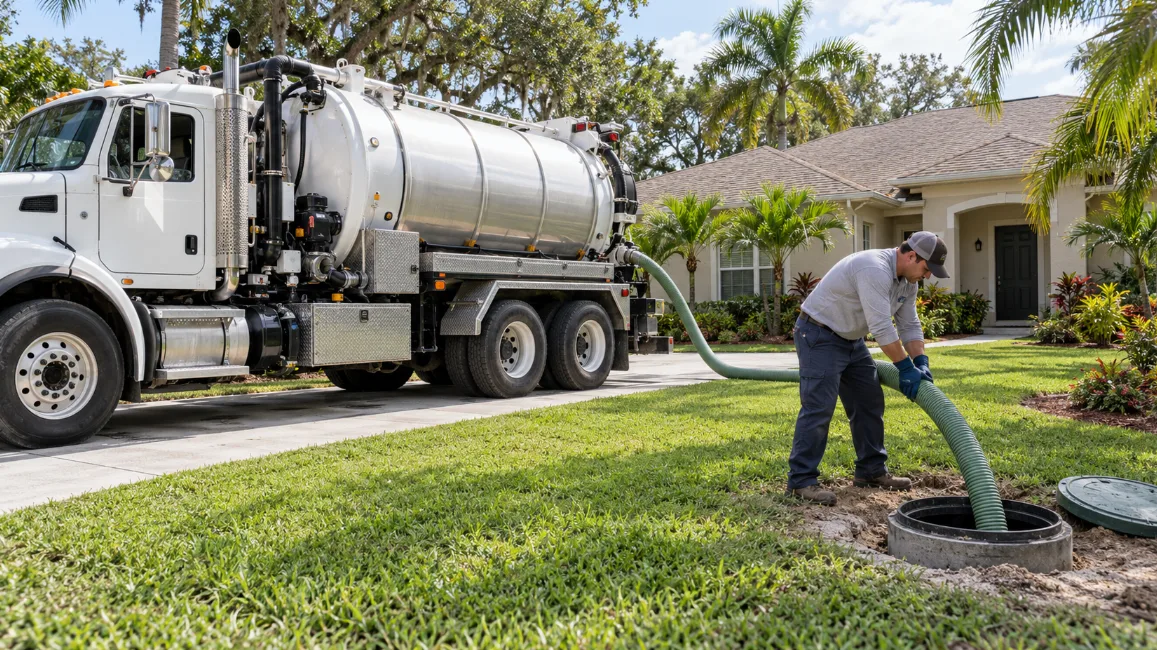
Septic tank pumping, cleaning, inspections, repairs, installation and replacement for residential and commercial properties. We tailor the scope to the property, wastewater use and installed equipment.
Pumping removes accumulated sludge and floating waste before solids escape into the drain field. Cape Coral homes may have 900- to 1,500-gallon residential tanks; confirm the installed size from the permit record. A tank that refills quickly after service may have a field, outlet or groundwater problem.
Explore Septic ServiceCleaning targets deposits left after bulk waste removal. We explain the difference between a standard wash-down and a deeper cleaning scope, including whether pumping and disposal are included. Concrete, fiberglass and polyethylene tanks need suitable cleaning methods.
Explore Septic ServiceAn inspection reviews accessible tank components, waste levels, records and signs of field trouble. Cape Coral home additions, property purchases and recurring wet-season problems deserve a clearly defined inspection scope. A private condition assessment does not replace county permitting.
Explore Septic ServiceA damaged lid, tee, filter, connection or dosing component may be repairable without replacing the entire system. Structural damage and recurring field failure require a different assessment. We identify the cause, the repair scope and any DOH-Lee approval needed.
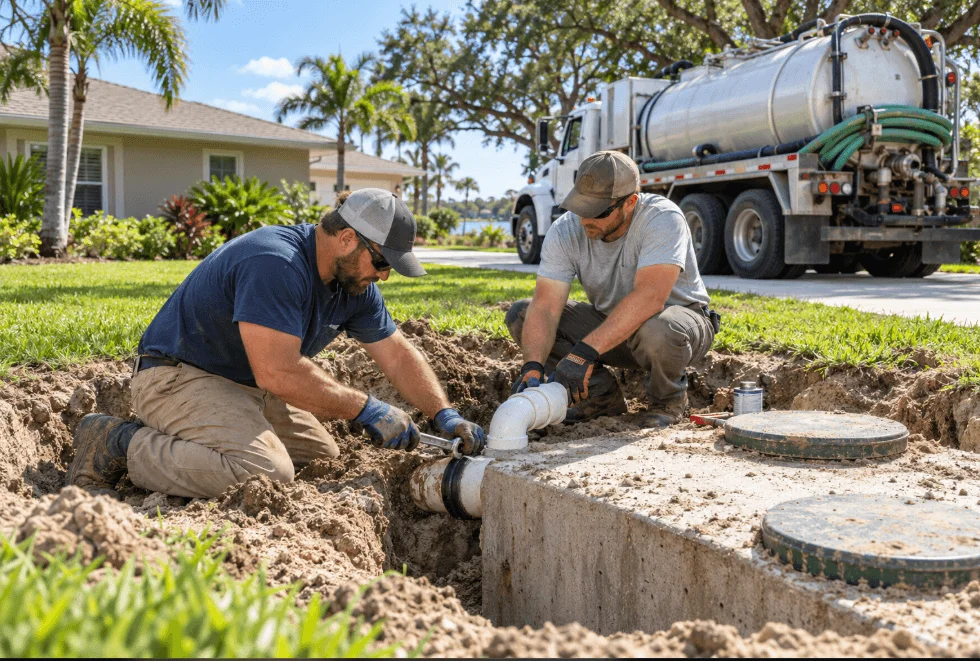
Explore Septic ServiceNew installation and replacement in Cape Coral depend on the house, usable soil, seasonal high groundwater and sewer availability. Florida sizes residential systems using bedrooms and building area. Submit the required plans and site evaluation to DOH-Lee before construction.
Explore Septic ServiceBackups, surfacing sewage and high-water alarms need prompt assessment. Reduce water use and keep people away from wastewater. We review whether pumping is safe and useful, especially after Cape Coral's heavy summer rain. Emergency availability is confirmed for the request.
Explore Septic Service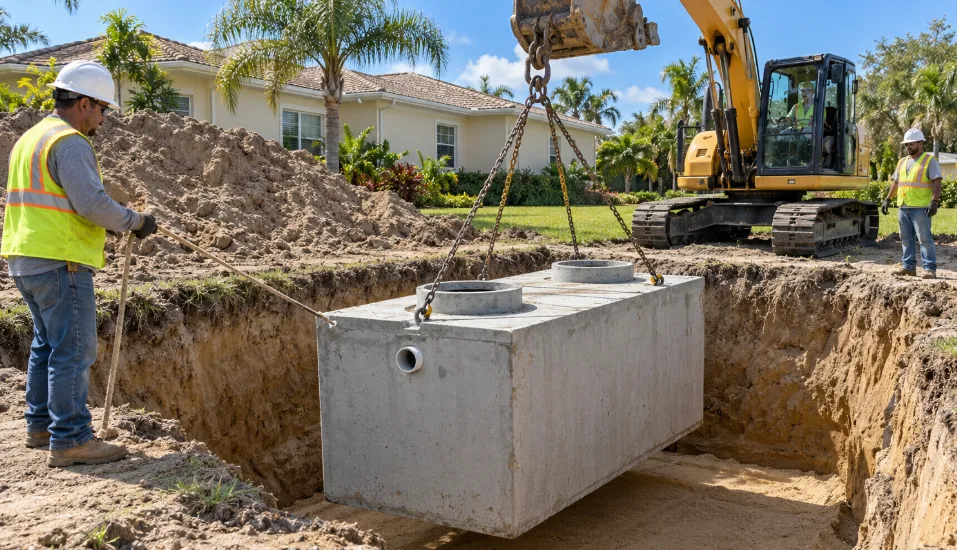
Drain field inspections, repairs and replacement for residential and commercial properties. We review distribution, soil, groundwater and wastewater demand before recommending work.
Repair starts with the distribution system and the soil receiving the wastewater. A damaged pipe, blocked distribution box and saturated field need different responses. Cape Coral rainfall and seasonal groundwater belong in the assessment before choosing excavation, aeration or replacement.
Explore Drain Field ServiceA field inspection reviews signs of poor absorption, accessible distribution parts, records and site changes. In Cape Coral, storm timing and seasonal water levels help explain repeat backups. We define what can be inspected and what additional testing may be needed.
Explore Drain Field ServiceReplacement needs enough suitable receiving area, the right elevation and DOH-Lee approval. Cape Coral properties can face seasonal groundwater, nearby wells or lakes, and yard changes that limit options. Review the whole layout and sewer availability before selecting a new field.
Explore Drain Field ServiceStart with sewer availability, the actual floor plan and the ground conditions before choosing a tank or replacement field.
Realtor.com data published by FRED reports a 1,661-square-foot median for Lee County home listings in September 2026. This is county listing-market context, not the average size of every Cape Coral home or a survey of septic-served houses. For discussion, consider a three-bedroom, two-bath home around 1,650 square feet; that is an illustrative floor plan rather than a measured local bedroom or bathroom average. FRED county table · Lee County series and methodology.
Florida considers both bedrooms and building area. When those categories differ, the greater calculated sewage flow controls. Bathroom count alone does not select the system. For a matched three-bedroom home of 1,201–2,250 square feet, the state example is 300 gallons per day of design sewage flow and 900 gallons of minimum effective tank storage.
| Dwelling example | Design sewage flow | Minimum effective tank storage |
|---|---|---|
| 2 bedrooms, 751–1,200 sq ft | 200 gallons/day | 900 gallons |
| 3 bedrooms, 1,201–2,250 sq ft | 300 gallons/day | 900 gallons |
| 4 bedrooms, 2,251–3,300 sq ft | 400 gallons/day | 1,050 gallons |
| Approved residential design flow of 401–500 gallons/day | 401–500 gallons/day | 1,200 gallons |
These are minimum storage examples from Rule 62-6.008, not a count of tanks installed in Cape Coral or a complete approved system design. A tank may be larger than the minimum. Treatment equipment and the drain field have separate sizing requirements; confirm the actual model, compartments and permit record. Florida sizing rule · Tables I and II.
DOH-Lee remains the local septic permitting and inspection contact under Florida DEP’s onsite sewage program. Cape Coral building, utility-connection and related city approvals are separate. Lee County’s published engineering requirement for all new systems in unincorporated Lee County should not be treated as a blanket citywide Cape Coral requirement; have the authority confirm the design obligations for your parcel and system type. DOH-Lee septic program · New-system application requirements · City permitting.
Allow 4–6 business days as an initial planning allowance for processing a complete, paid septic application. This is a planning estimate rather than a guaranteed DOH-Lee turnaround. Missing documents, office workload, the site evaluation, engineering, treatment requirements or city/utility coordination can extend the schedule. Confirm the current review queue before setting an installation date.
| Project stage | Timing guidance | What to confirm |
|---|---|---|
| Application preparation and site evaluation | Schedule before relying on a processing estimate | Survey, floor plan, groundwater/soil evaluation and any engineering |
| Complete, paid application review | 4–6 business days as an initial planning allowance | The live DOH-Lee review queue and missing-information requests |
| System repair permit | State rule directs an effort to issue within two working days | Whether the submitted scope qualifies and any unresolved information |
| Construction and final inspection | Arrange separately after the appropriate authorization | Installer availability, wet ground, inspection stages and final approval |
The two-working-day repair provision is an effort target, not a guaranteed approval, repair visit or installation date. Lee’s online service publishes review and inspection dates weekly and forwards applications for review only after payment and completion. Use that portal or contact DOH-Lee for the current project-specific schedule. Review and inspection dates · Application status · Repair permit rule.
DOH-Lee lists a $390 new-system application fee, an additional $155 if its site evaluation is needed, and a $465 performance-based-system application fee. Its repair page lists $350. Confirm the current fee for your scope; agency fees are separate from contractor service prices. New-system package and fees · Repair application and fees.
Cape Coral’s Utilities Extension Project changes which properties should remain on septic. The city’s published guidance says developed properties in an activated project area must connect within 180 days of the Notice of Availability. Confirm the deadline and conditions on your actual notice. Connection and septic abandonment require their own permits and inspections; a new tank or drain field does not cancel a sewer-connection obligation. City connection information · UEP connection process.
Groundwater and canals: the city identifies movement of failed-system effluent toward groundwater and canals as a reason for utility expansion. Soil treatment needs usable separation above wet-season groundwater; surface appearance alone does not establish suitability.
Storms and flooded ground: reduce wastewater use, avoid contact with sewage and obtain professional assessment. Pumping an empty tank in saturated ground can create movement or flotation risks; another pump-out does not dry the surrounding field.
Small-lot layouts and additions: pools, canal edges, wells, drainage, easements and access can compete for usable treatment space. Review the current survey and septic approval before enlarging a home or moving a field.
Address-specific nitrogen reduction: new systems on lots of one acre or less in impacted BMAP or alternative-restoration areas can require enhanced treatment. Check DEP mapping and the permitting authority; do not assume every Cape Coral repair or replacement needs the same equipment.
City UEP background · UF/IFAS groundwater and treatment guidance · EPA flooded-system guidance · DEP nutrient-reduction requirements
Overdue pumping lets sludge and floating waste build up. Escaped solids can clog the field.
Running toilets, leaks and back-to-back laundry loads can overwhelm the system’s capacity.
Grease and wipes obstruct flow. Harsh chemicals can disrupt treatment and harm the system.
Saturated ground leaves too little space for wastewater to drain and receive soil treatment.
Roots can enter openings. Vehicles crush components or compact soil. Broken fittings also disrupt flow.
Deteriorated or undersized systems struggle. On advanced systems, missed pump and aerator care can interrupt treatment.
A septic system is more than a tank. Its storage capacity, treatment process and drain field each do a different job. Use this guide to understand home size, tank materials, expected lifespan and Cape Coral conditions before choosing a service.
Lee County’s September 2026 listed-home median provides a local size reference, but your own plans and approval control the project. A three-bedroom home around 1,650 square feet is an illustrative case. Adding a bedroom, enclosing a room or changing a commercial use can change the required sewage flow even if the existing tank still appears to work.
Keep the permit, layout, maintenance reports and equipment information together. Before a sale or renovation, compare the record with the actual building and ask what further evaluation is needed. Cape Coral home sizes and permit planning.
The effective gallon capacity of the tank describes stored liquid, not the amount the property may discharge every day. Florida’s residential storage examples include 900, 1,050 and 1,200 gallons as approved flow increases. A treatment unit’s gallons-per-day rating describes another part of the design; neither figure alone establishes the field area.
A three-bedroom plan within the corresponding 1,201–2,250-square-foot category has a 300-gallon-per-day design-flow example and 900-gallon minimum effective tank storage. Where bedrooms and floor area fall into different categories, use the greater resulting flow. Confirm the permit and installed model instead of inferring tank size from bathrooms or a real estate listing. State sizing rule.
Usable soil, wet-season groundwater, loading rate, available area and setbacks influence the layout. A larger tank cannot create more unsaturated soil. A small yard with a pool, canal frontage, utilities and easements deserves a coordinated plan before equipment is chosen.
A substantial shell that needs lifting access and a suitable base. Check accessible covers, seams, walls and fittings. Tank weight does not eliminate groundwater uplift risk when the vessel is empty.
A lighter composite option whose approved support, burial and backfill requirements matter. Inspect shell damage and connections and verify that the selected model fits the site conditions.
A molded shell that depends on correct bedding, depth and backfill to resist deformation or movement. Follow the model’s approval and manufacturer instructions rather than applying one installation method to every tank.
The tank shell, soil field, pump, aerator and controls have different functions and maintenance needs. A failed float does not automatically mean the whole system needs replacement, and a sound tank does not prove the field is accepting flow.
Expected service life depends on the installed product, site conditions and maintenance. Ask what remains in use, what the proposal replaces and what care or operating obligations apply after the work.
Conventional tanks separate solids before effluent enters the soil treatment area. Aerobic units add a treatment process with powered equipment. Performance-based systems are designed around specified treatment goals. Tank material alone does not establish the treatment type or prove that a system meets nitrogen-reduction requirements.
DOH-Lee identifies operating-permit requirements for aerobic, performance-based and certain commercial or industrial systems. Understand the maintenance contract, inspection and permit obligations when comparing options. Check the address and project classification before assuming that a conventional design is allowed or that advanced treatment is required everywhere. Lee County application and operating-permit types · DEP treatment requirements.
Cape Coral’s water setting makes proper containment and soil treatment important. The city’s UEP information describes concerns about failed-system effluent reaching groundwater and canals. Assess the actual wet-season water table and proposed field elevation instead of assuming sandy soil alone is suitable. City utility-expansion background.
Heavy rain can reduce the soil’s ability to receive effluent while household water use continues. A storm-related backup needs review of access, water levels, filters, pumps and distribution. Pumping does not lower the surrounding groundwater, and emptying a tank in saturated ground can create movement or flotation risks. EPA guidance after flooding.
Before investing in a field replacement, confirm whether the address has available sewer or a Notice of Availability. A planned future project and activated utility service are different situations. Follow the notice and current city requirements, then coordinate connection and authorized septic abandonment with the appropriate contractors and inspectors. City utility-connection information.
A leaking riser, broken tee or damaged line needs a different scope from a failing field. A new pool, addition, grading change or extended driveway can also affect access and treatment space. Bring the current survey and permit record into the discussion before moving components or covering usable soil.
Business use, grease-bearing waste, busy operating periods and specialized equipment can change the required service plan. Describe the facility and waste type when requesting work. Residential storage examples are not a substitute for a commercial design.
Confirm sewer availability first, then prepare the proper DOH-Lee application, survey, site/floor plans, evaluation, fees and design documentation. City building and utility work may require parallel approvals. Keep permit conditions and inspection stages in the work proposal so the project can be scheduled around what is actually authorized.
Use the complete-application planning allowance separately from evaluation, design and construction time. Check Lee’s current review dates and respond promptly to missing-information requests. Repair, new-system, addition and abandonment applications are different scopes. Detailed local process, fees and timing · DOH-Lee online services.
Useful Florida residential storage examples include 900, 1,050 and 1,200 gallons as design flow increases. A matched three-bedroom, 1,201–2,250-square-foot home has 900-gallon minimum effective storage; a matched four-bedroom, 2,251–3,300-square-foot home has 1,050 gallons. These are rule examples, not a measured local installed-tank average.
Realtor.com data published by FRED reports a 1,661-square-foot median for Lee County home listings in September 2026. It is county market context, not an average of all Cape Coral homes or a septic-only measure.
DOH-Lee remains the local septic permitting and inspection contact under the Florida DEP program. Cape Coral building, utility and connection permits are separate.
Allow 4–6 business days as an initial planning allowance for processing a complete, paid septic application. This is a planning estimate rather than a guaranteed DOH-Lee turnaround. Missing documents, office workload, the site evaluation, engineering, treatment requirements or city/utility coordination can extend the schedule. Confirm the current review queue before setting an installation date. Florida’s repair rule directs an effort to issue within two working days; that is not a guaranteed approval or repair appointment.
DOH-Lee lists a signed construction-permit application, site plan, floor plan, survey and fees, with the necessary evaluation and design information. Engineering or special treatment may be required for the property.
Requirements depend on the system, scope and jurisdiction. DOH-Lee’s new-system page specifically says all new applications in unincorporated Lee County need Florida professional-engineer design; do not extend that wording automatically to every property inside Cape Coral.
Check the actual service status and city notice first. The city’s UEP guidance describes connection within 180 days after a Notice of Availability for developed properties in an activated project area. Confirm your notice, permit and abandonment obligations before investing in replacement.
A blocked outlet, failed pump, overloaded field or high groundwater can make the problem return. Removing tank contents does not dry saturated soil or repair damaged distribution.
Avoid blind pumping during flooded or saturated conditions. Reduce water use and obtain professional assessment because an emptied tank can move or float.
No single answer applies to every address and scope. New systems on lots of one acre or less in impacted BMAP or alternative-restoration areas can require enhanced treatment. Confirm DEP mapping, sewer availability and the actual permit classification.
Use occupancy, capacity, solids observations and the equipment’s maintenance requirements to set the plan. DOH-Lee recommends pumping household tanks every three to five years; advanced systems have additional operating and maintenance obligations.